Lean principles / History of lean
History of lean: from the Venetian Arsenal to today's robots
Lean did not appear out of nowhere in Japan. The staged flow of the Venetian Arsenal, interchangeable parts, Ford's assembly line, the Toyoda loom and Deming's method are milestones of the same idea: eliminate whatever does not add value. Here are the main milestones, and what remains of them on today's shop floor.
The milestones
12th–16th century
The Venetian Arsenal
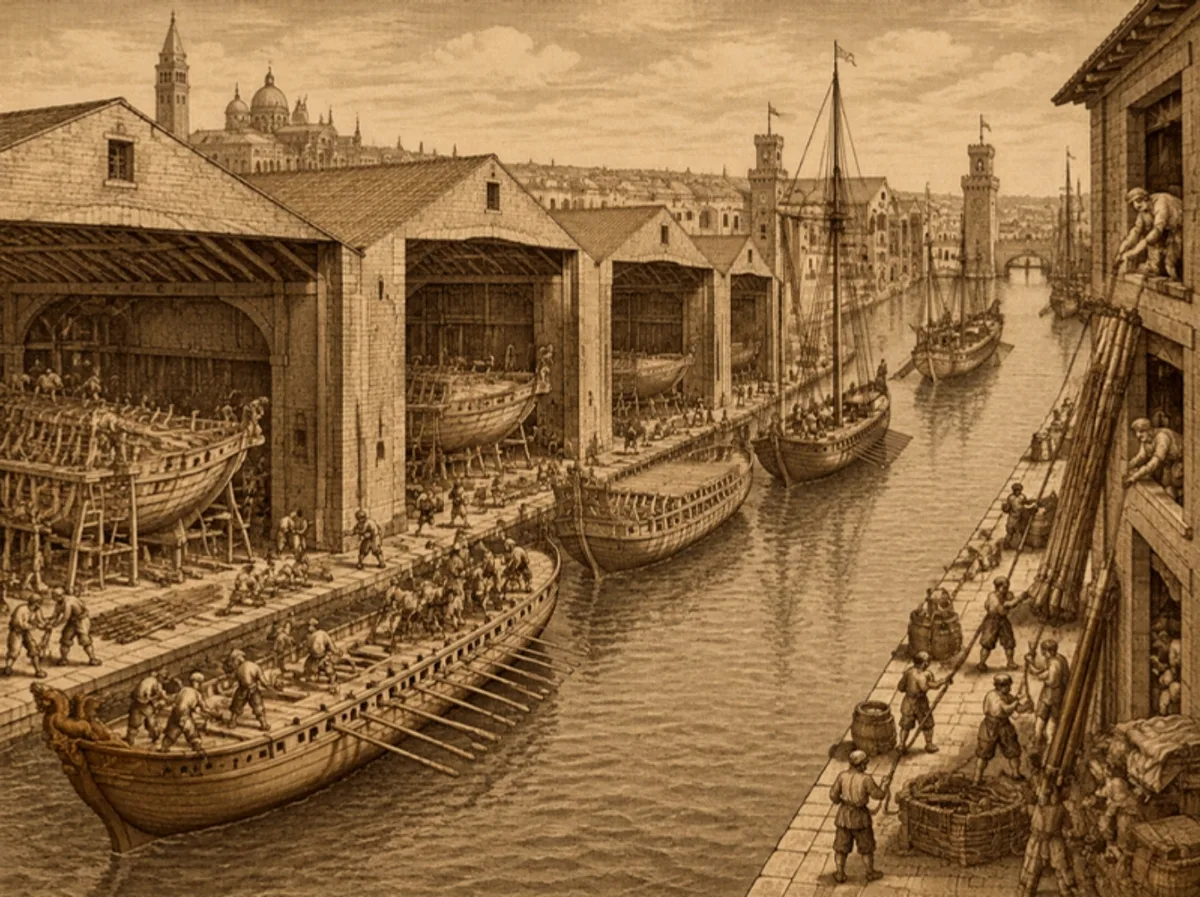
Founded according to tradition in 1104, the Arsenal built galleys in stages: the hull moved from one shed to the next while prefabricated parts waited in the warehouse. In 1574 King Henry III of France watched every stage in the construction of a galley; and at the Battle of Lepanto (1571) more than half of the Holy League fleet had come out of it.
Late 18th century
Interchangeable parts
Honoré Blanc in France and Eli Whitney in the United States promote firearms with interchangeable parts: the prerequisite for all mass production.
1911
Taylor and the Gilbreths
Frederick Taylor publishes The Principles of Scientific Management; Frank and Lillian Gilbreth study operator motions. The idea of a standard method is born.
1913
Ford and the moving line
At Highland Park, Ford introduces the moving assembly line: the product moves, the operator stays at the workstation. Flow becomes the center of the factory.
1924
Sakichi Toyoda and jidoka
Sakichi Toyoda's automatic loom stops by itself when a thread breaks: a machine that does not produce defects. This is the origin of jidoka.
1930s
Kiichiro Toyoda and just-in-time
His son Kiichiro starts car production (Toyota Motor was founded in 1937) with a simple idea: produce only what is needed, when it is needed.
1950
Deming in Japan
W. Edwards Deming teaches Japanese industrialists statistical quality control and the improvement cycle derived from Shewhart, which will become PDCA.
1950s–1970s
Ohno, Shingo and TPS
Taiichi Ohno builds the Toyota Production System: kanban, supermarkets inspired by American grocery stores, leveling. Shigeo Shingo develops quick changeover (SMED) and poka-yoke.
1970s
TPM and the oil crisis
Total Productive Maintenance is born in Japan. After the 1973 oil crisis Toyota proves more resilient than its competitors, and TPS starts being studied outside the company.
1988–1996
The word “lean” is born
John Krafcik coins “lean production” in 1988; in 1990 The Machine That Changed the World by Womack, Jones and Roos makes it known worldwide; in 1996 Lean Thinking sets out the five principles: value, value stream, flow, pull, perfection.
2000s
World Class Manufacturing
Hajime Yamashina develops WCM, which Fiat adopts in the mid-2000s across all its plants: 10 technical pillars, 10 managerial pillars and Cost Deployment to choose where to act.
Today
Industry 4.0, 5.0 and autonomous logistics
The principles have not changed; the tools have: mobile robots running the shuttle trips, real-time data, a focus on people. A kanban is still a card and a FIFO lane is still a lane.
Tools to get started
The pillars on one page
One page for each principle
Let's start from your shop floor
Have an industrial project to develop?
Choose where to start. Or call us: +39 0434 572757.
Robot demo at your site
We bring the robot to your shop floor and you see it working on your own routes.
On-site visit
We come to see your shop floor, flows and spaces, and propose the right solution.