Lean principles / WCM and TPS
WCM and TPS: the pillars, and where they meet the shop floor
The Toyota Production System and World Class Manufacturing are the two most widely used models for organizing a lean factory. Here we sum them up on one page and, for each pillar, point to the page explaining what you need to put it into practice.
The Toyota Production System house
Two pillars, a roof and a foundation: if the foundation is not stable, the pillars will not hold.
The roof: the goal
Higher quality, lower cost, shorter lead time
Pillar 1
Just-in-Time
Produce and deliver only what is needed, when it is needed, in the quantity needed: pull, continuous flow, takt time.
Pillar 2
Jidoka
Autonomation: the process stops by itself at the first defect, the andon calls for help, poka-yoke prevents the mistake.
The foundation
Heijunka (leveled load) · Standard work · Kaizen · Stability and 5S
The 10 technical pillars of WCM
World Class Manufacturing, developed by Professor Hajime Yamashina and adopted by Fiat in the mid-2000s, has 10 technical and 10 managerial pillars. People often speak of 11 technical pillars because Autonomous Activities are split into Autonomous Maintenance and Workplace Organization.
Pillar 2
Cost Deployment
Losses and waste are mapped into costs to decide where to act first.
Pillar 3
Focused Improvement
Targeted projects on the biggest losses, with a structured method and verified results.
Pillar 4
Autonomous Activities
Autonomous maintenance of machines and workplace organization.
Pillar 5
Professional Maintenance
Zero breakdowns through preventive and predictive maintenance.
Pillar 6
Quality Control
Zero defects: the conditions that create defects are eliminated at the source.
Pillar 8
Early Equipment and Product Management
New equipment and products designed from the start with the people who will use and maintain them in mind.
Pillar 10
Environment and Energy
Less waste, less consumption, less impact.
The 10 managerial pillars of WCM
The organizational conditions without which the technical pillars stay on paper.
1
Management commitment
2
Clarity of objectives
3
Route map to WCM
4
Allocation of highly qualified people to model areas
5
Commitment of the organization
6
Competence of the organization towards improvement
7
Time and budget
8
Level of detail
9
Level of expansion
10
Motivation of operators
TPS and WCM compared
TPS was born at Toyota between the 1950s and 1970s and is a production system: it defines how material should flow and how to react to problems. WCM is an improvement management system: it starts from the cost of losses to decide where to apply lean, TPM and quality tools.
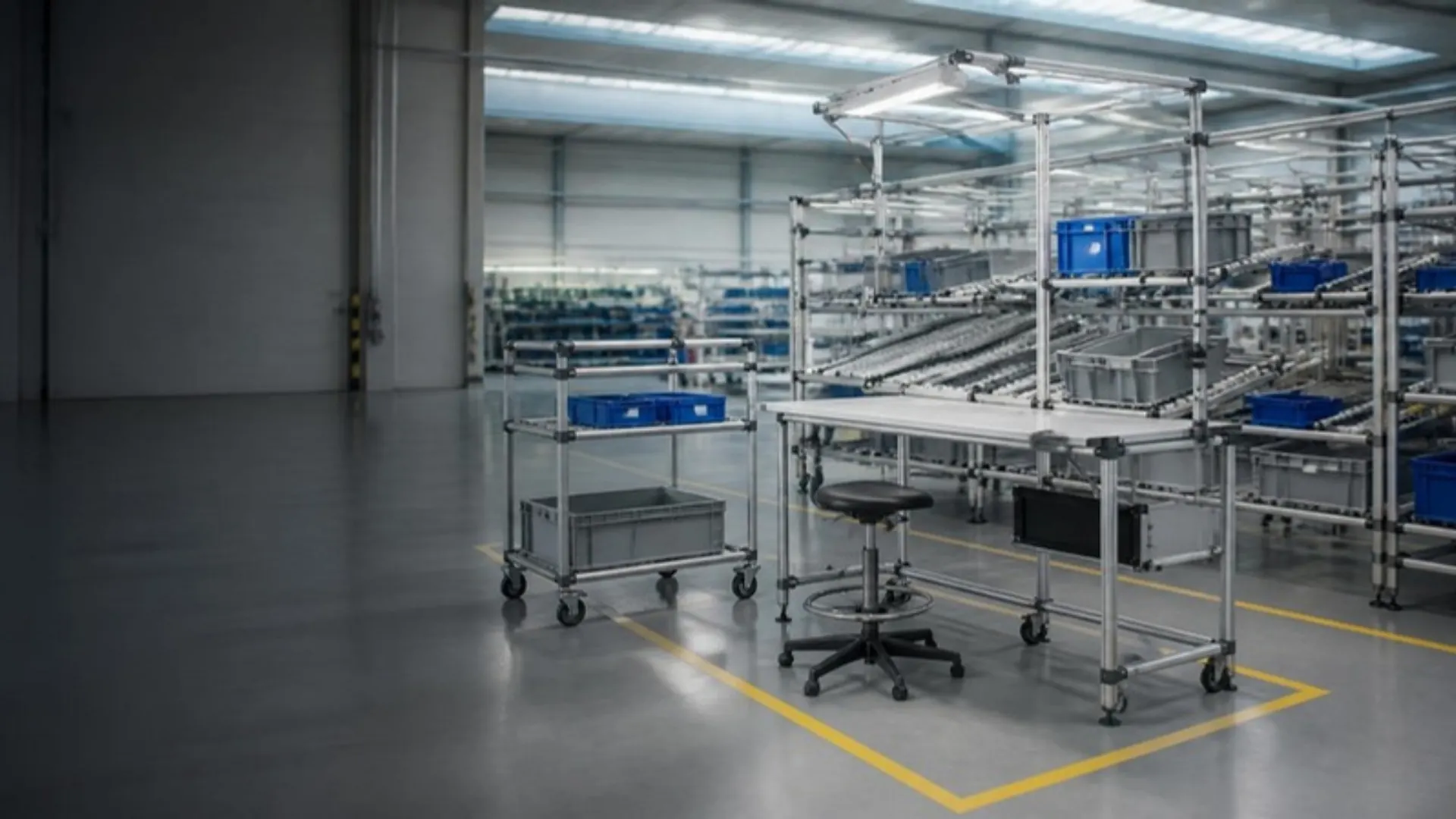
On the shop floor they meet on the same objects: a FIFO lane, a kanban board, a workstation at the right height, a marked pedestrian walkway. That is where our products come in. The story of how we got here, from the Venetian Arsenal to today, is in History of lean.
Tools to get started
From the Venetian Arsenal to today
One page for each principle
Let's start from your shop floor
Have an industrial project to develop?
Choose where to start. Or call us: +39 0434 572757.
Robot demo at your site
We bring the robot to your shop floor and you see it working on your own routes.
On-site visit
We come to see your shop floor, flows and spaces, and propose the right solution.