- All Products
- AL Modular System
- Strut profiles
- Slot C6 (6 mm)
- Aluminium strut profile 20x40
Aluminium strut profile 20x40
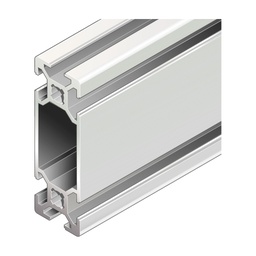
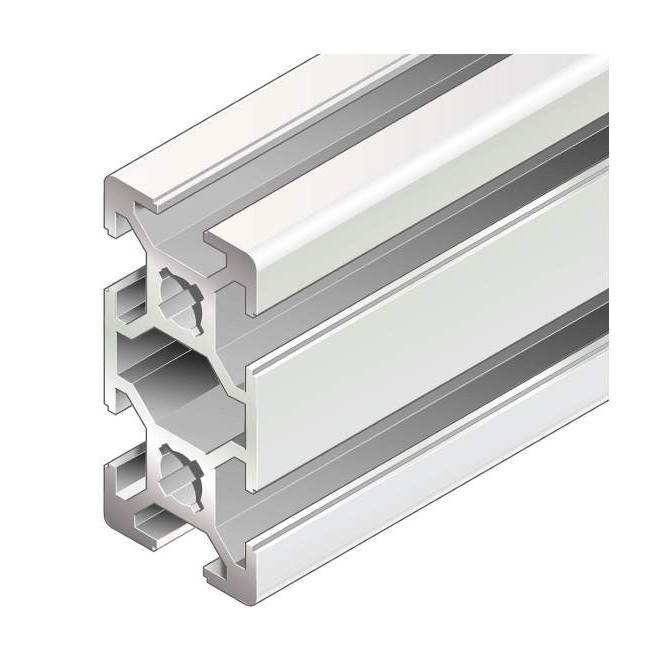
https://leanproducts.eu/shop/3842992891-aluminium-strut-profile-20x40-2802 https://leanproducts.eu/web/image/product.template/2802/image_1920?unique=1d9bc53Anodised aluminium strut profile 20x40 mm with six 6 mm slots: stiffer than the 20x20 in one direction, for crossbars, reinforcements and light frames. 0.8 kg/m, 3000 mm bar or cut to length from 50 mm.
AL Modular System · C6 profiles
Aluminium strut profile 20x40 – slotted profile with 6 mm slot for crossbars
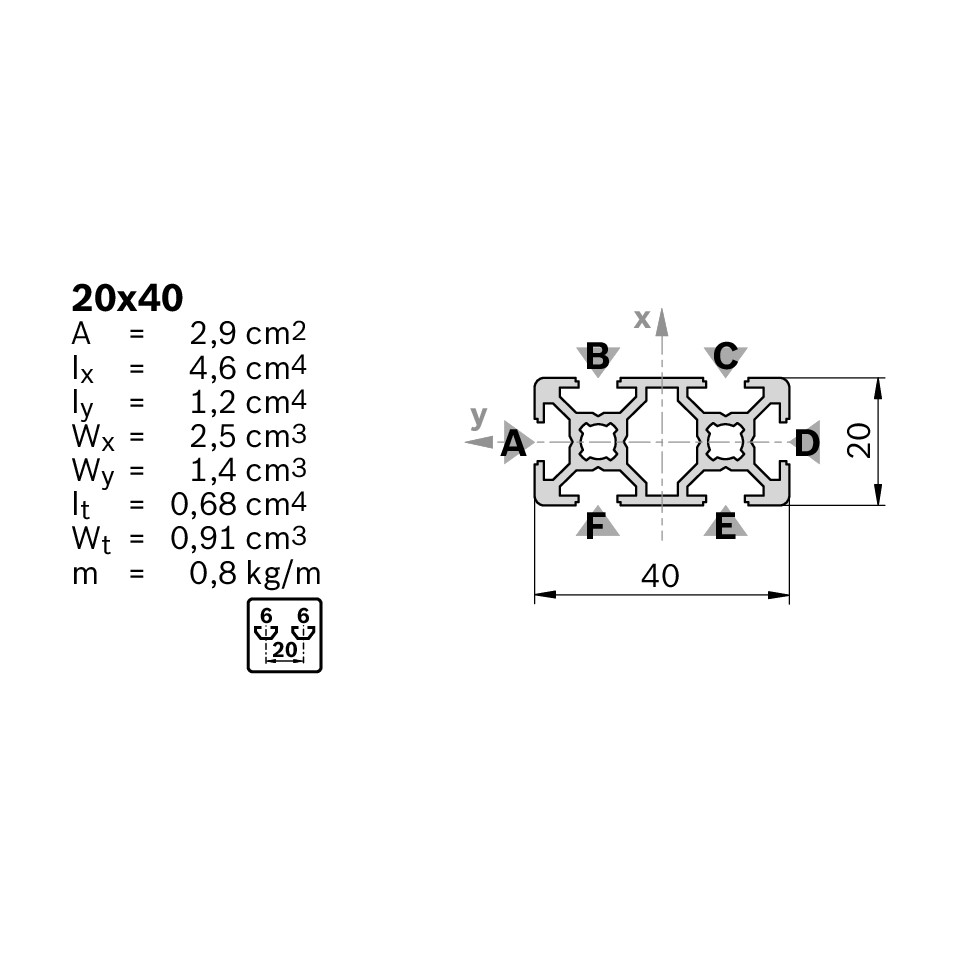
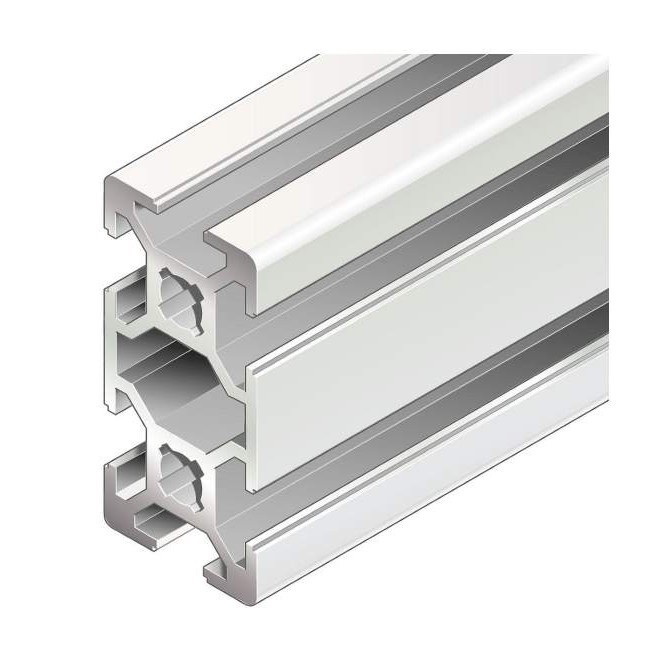
The 20x40 is the 6 mm series profile for crossbars and reinforcements. Mounted upright it has a moment of inertia of 4.6 cm⁴, more than six times that of the 20x20, and sits alongside the structure's 20x20 profiles with the same nuts. Six slots, 0.8 kg/m: use it for the crossbars of guards, display cases, light shelving and bench equipment.
Why choose it
Stiff where it matters
Upright it is more than six times stiffer than the 20x20: longer crossbars without changing series.
Six slots
Two on each long side and one on each short side: room for panels, brackets and accessories.
Stronger joints
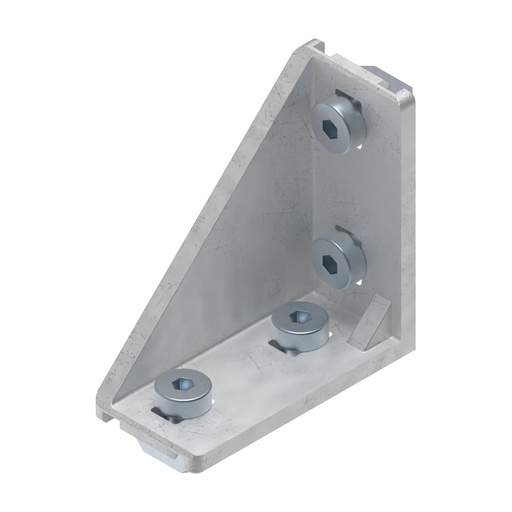
The bracket 20x40 is fixed with four M4 screws at 3 N·m and holds 1400 N, twice the 20x20 bracket.
Cut to length
3000 mm bar or pieces cut from 50 mm upwards, ready to assemble.
Choose it if…
- You need a crossbar or reinforcement in a 20 series structure.
- The load acts in one direction: you mount the profile with the 40 mm side vertical.
- You want more slots on the same profile to fix accessories.
- You want to stay with 6 mm slot nuts and screws.
Choose another solution if…
- You need even more vertical rigidity (Ix 14.2 cm⁴): Aluminium strut profile 20x60 →
- The structure is light and spans are short: Aluminium strut profile 20x20 →
- You must carry medium loads, such as trolleys and support frames: Aluminium strut profile 30x60 →
Not sure which profile to choose? Open the guide with the profile table →
How to assemble
Three practical rules for the 20x40:
Orientation
Upright (40 side vertical) Ix = 4.6 cm⁴; flat Iy = 1.2 cm⁴. A load-bearing crossbar goes upright.
Same module
40 is twice the 20 module: the 20x40 sits alongside and crosses 20x20 profiles without shims.
End
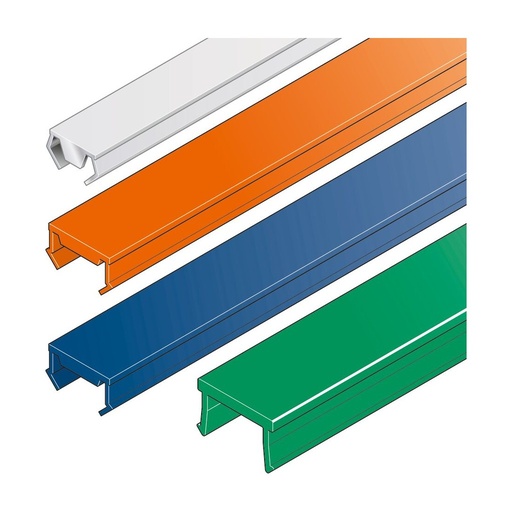
Closed with two cover caps 20x20, grey or black ESD.
Send us the parts list or a sketch: we check codes and quantities of profiles, brackets and nuts.
The LeanProducts service
From the parts list to pieces ready to assemble:
Cutting to length
We cut the profiles in our workshop to the lengths in your parts list.
Parts list check
We start from your parts list or a sketch and check codes and quantities of profiles, brackets, nuts and cover caps.
Ready-to-assemble kits
You receive cut profiles and small parts grouped by structure, with the list of components.
Spare parts and modifications
When the structure changes we supply new cuts and the components to extend it.
Send us a sketch with the overall dimensions: we reply with codes, quantities and cut lengths.
Technical data
| Property | Value |
|---|---|
| Code | 3842992891 |
| Section | 20x40 mm |
| Slot | 6 mm, six slots |
| Cross-sectional area | 2.9 cm² |
| Weight | 0.8 kg/m |
| Moment of inertia | Ix = 4.6 cm⁴ · Iy = 1.2 cm⁴ |
| Section modulus | Wx = 2.5 cm³ · Wy = 1.4 cm³ |
| Torsion | It = 0.68 cm⁴ · Wt = 0.91 cm³ |
| Maximum length | 3000 mm |
| Minimum cut length | 50 mm |
| Alloy and finish | EN AW-6063 (AlMgSi) extruded, anodised E6/EV1, 12 µm |
| Cover cap | 2 cover caps 20x20 side by side |
Ix applies with the 40 mm side vertical (profile upright), Iy with the profile laid flat.
Downloads
Need help with your profile parts list?
Send us a sketch or the parts list: we will give you codes, accessories and cut lengths.
Specifications
| Brand | Bosch Rexroth |
| Section mm | 20x40 |
| Slot mm | 6 |
| Cross-section area cm² | 2.9 |
| Moment of inertia Ix / Iy cm⁴ | 4.6 / 1.2 |
| Section modulus Wx / Wy cm³ | 2.5 / 1.4 |
| Max length mm | 3000 |
| Alloy | EN AW-6063 (Al MgSi) |
| Production method | Extrusion |
| Surface treatment | Anodising E6/EV1, 12 µm, 300 HV |
| Coefficient of thermal expansion | 23.4 × 10⁻⁶ 1/K (+20…100 °C) |
| Tensile strength | 245 N/mm² |
| Yield strength | 195 N/mm² |
| Elongation at break | 10% |
| Modulus of elasticity E | 70000 N/mm² |
| Brinell hardness | 75 HB |
| Straightness tolerance | max 0.75 mm/m |
| Torsion tolerance | max 0.70 mm/m |
| Torsion factor It cm⁴ | 0.68 |
| Torsion factor Wt cm³ | 0.91 |
| Min length mm | 50 |
| Length | 3000 |
| Weight | 0.8 kg/m |
| Material | Anodized aluminium |
With the 40 mm side vertical: the moment of inertia is 4.6 cm⁴, compared with 1.2 cm⁴ with the profile flat. For the same load and span an upright crossbar deflects almost four times less.
Only for light loads and mounted on edge: in its plane it has Ix = 3.2 cm⁴, flat barely 0.2 cm⁴. For a 20 series cross member choose the 20x40, which has the same width.
The bracket 20x40 for 6 mm slot: it is fixed with four M4x8 screws tightened to 3 N·m and holds 1400 N. If you order it without screws and nuts, add four M4 screws and four M4 nuts per joint to the parts list.
The 20x40 is rigid mainly in one direction (Ix 4.6 cm⁴, Iy 1.2 cm⁴). The 20x40x40 has 6.0 cm⁴ in both directions and It 1.5 cm⁴: it is the corner post for light structures loaded from several sides.
The 20x60 is for longer or more heavily loaded crossbars: Ix 14.2 cm⁴, about three times the 20x40, at 0.9 kg/m instead of 0.8. For short spans the 20x40 is enough and more compact.
With two cover caps 20x20 side by side, signal grey or black ESD: they cover the cut and the slots.
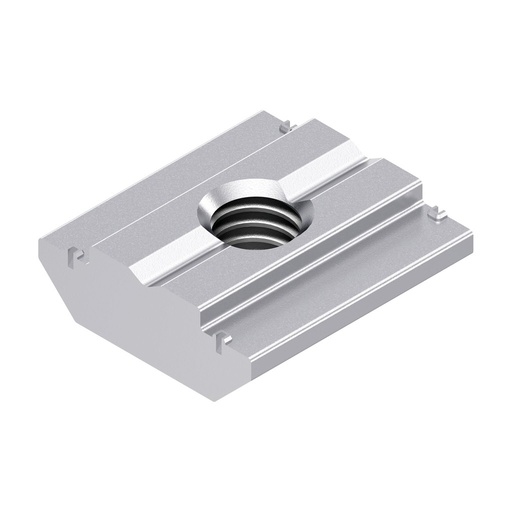
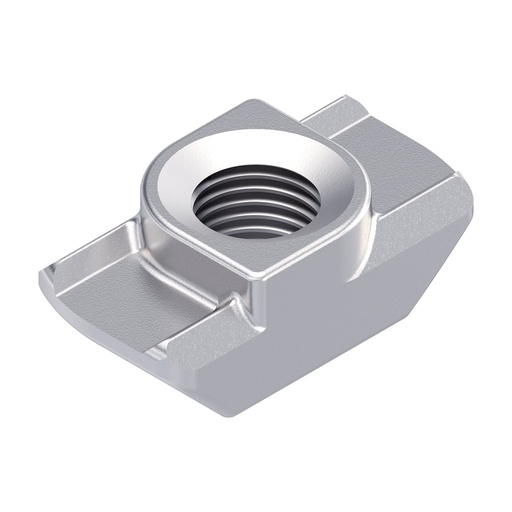
Those for the 6 mm slot: M4 T-nut (1700 N) or M4 and M5 sliding block (3000 N). They are the same as for the 20x20: in a 20 series structure you need only one type of small parts.
It is the width of the profile slot and determines which accessories you use. Slot C6 (6 mm) is for 20 series profiles, C8 (8 mm) for the 30 series, C10 (10 mm) for profiles from the 40 series upwards. Nuts, screws, brackets and cover caps are chosen by slot: each accessory's product page shows the right one.
Yes. You can order the full bar or the piece cut to the length you need: we do the cutting ourselves, in our workshop. Each profile's product page shows the maximum bar length and the minimum cut length.
Look at the moments of inertia Ix and Iy: the higher they are, the less the profile deflects under load. For the same section, “L” profiles are lightened and deflect a little more. For long spans or high loads move to a larger section or a tall profile (e.g. 45x90 instead of 45x45). If you send us drawing and loads, we will check the choice.
The T-nut is inserted from the front into the slot, even in an assembled structure, and positions itself when you tighten the screw: it is the standard choice for fixing accessories. The sliding block withstands higher forces, but normally has to be inserted from the profile end before closing the frame; spring versions stay where you put them.
The simplest way is the bracket, which joins two profiles at 90° with screws and nuts in the slot, without machining. For end, T, 45° or three-way connections there are dedicated connectors, some of which require profile machining as stated on their product page.
Yes, for several accessories (for example cover caps, hinges and nuts) there are conductive ESD versions, indicated in the name or variant. Tell us which EPA area you work in and we will confirm the components to use.
On each product page you will find the MGE catalogue pages to download as PDF, with dimensioned drawings and technical data; the Specifications tab shows the data for the variant you have chosen.
Yes. Send us the parts list or a sketch with dimensions: we give you codes, quantities and cut lengths and prepare the kit with profiles already cut and the accessories.