Product families / Logistics robots
Robots for logistics and internal transport
Answer 4 questions: we will show you the PUDU robots suited to materials, carts, pallets and light deliveries. A single PUDU ecosystem for cleaning, delivery and logistics: same app, same reports.
Want to know how much you save? Try the ROI calculator with your routes, trips and current costs →
What do you need to transport?
How much does one trip weigh?
The heaviest load the robot has to carry in one trip.
What route does it take?
How do you call it?
PUDU robots for internal logistics
AMR robots and autonomous pallet truck
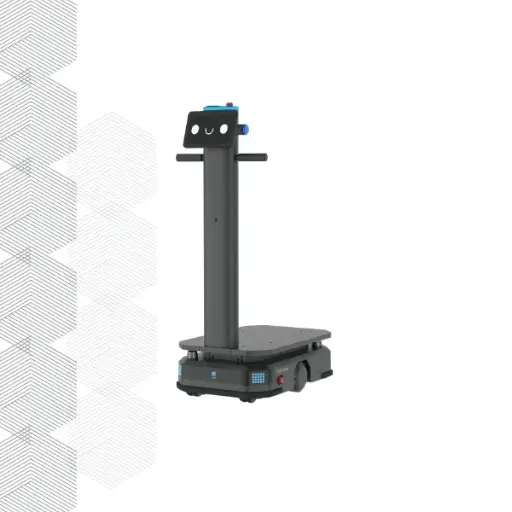
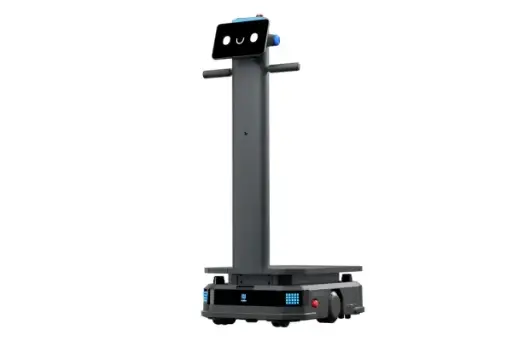 T300Bins, KLTs and parcels on the deck or trays; towing and roller conveyor with accessories.300 kg · fits through 60 cmSee →
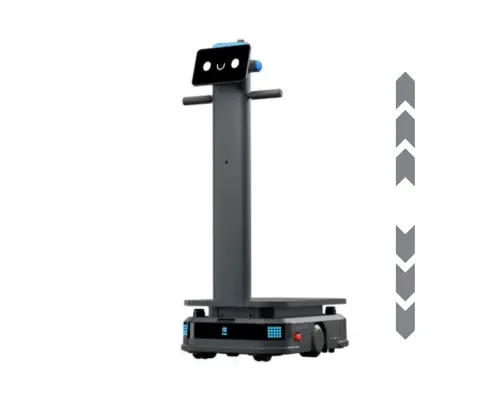 T300LSlides under the rack and lifts it: loading and unloading without an operator.300 kg liftedSee →
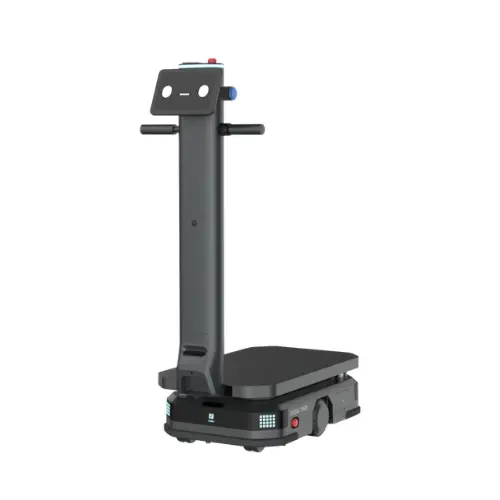 T600Heavy loads, with screen and handle; VDA 5050 and on-premise.600 kg · fits through 70 cmSee →
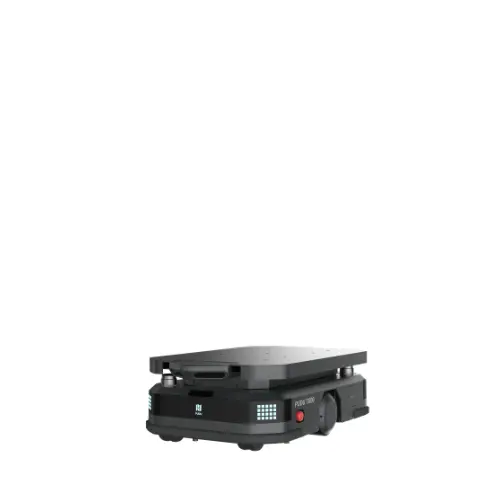 T600 Underride255 mm high: lifts the shelving and carts you already have; pallets with bracket.600 kg · fits through 65 cmSee →
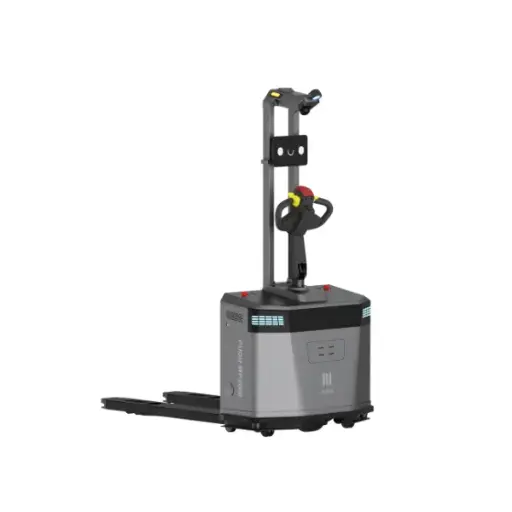 MP2000Floor-to-floor pallet transport between docks, warehouse and line side, without reflectors.pallets up to 2,000 kgSee →
Quick comparison
| Robot | What it carries | Payload | Minimum passage width | Thresholds and slope | Battery life | Navigation and safety | Calling and integration |
|---|---|---|---|---|---|---|---|
| T-series AMR robots | |||||||
| T300 | Bins, KLTs, parcels on deck or trays; towing and roller conveyor with accessories | 300 kg towing up to 400 kg | 60 cm 75 cm with roller conveyor | 20 mm; 5° 5 mm when towing | 12 h unloaded; 6 h at full load | VSLAM+; ISO 3691-4, CE-MD and CE-RED TÜV SÜD | Touchscreen, PUDU Pager, PUDU Link app, API; elevators and doors |
| T300L | Dedicated racks and carts, lifted from below | 300 kg | Depends on the rack | 20 mm; 5° | 12 h unloaded; 6 h at full load | VSLAM+; ISO 3691-4 | Touchscreen, PUDU Pager, PUDU Link app, API; elevators and doors |
| T600 | Heavy containers, components, material racks | 600 kg | 70 cm | 10 mm; 5° | 12 h unloaded; 6 h at full load | VSLAM and LiDAR SLAM; ISO 3691-4; emergency module | Call buttons, app, API, VDA 5050; on-premise |
| T600 Underride | Existing shelving, racks and carts; pallets with bracket | 600 kg lifted from below | 65 cm | 10 mm; 5° | 12 h unloaded; 6 h at full load | LiDAR SLAM; ISO 3691-4; automatic only | Call buttons, app, API, VDA 5050; on-premise |
| Autonomous pallet truck | |||||||
| MP2000 | Three-runner or perimeter-base pallets, floor to floor | 2,000 kg | 1.1 m unloaded 2 m aisle for 90° pick-up | 10 mm; 3° at full load | 12 h unloaded; 6 h at full load | 3D LiDAR and VSLAM | Task buttons, PUDU Link app, API, voice commands; manual tiller |
| Delivery robots | |||||||
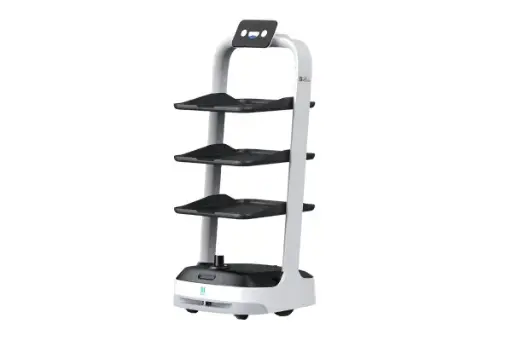
| PuduBot 2 | Dishes, materials and small supplies on 3 trays | 10 kg per tray up to 13 kg; 40 kg in total | 80 cm | 10 mm; 5° | 15 h unloaded; 12 h at full load | VSLAM+ and dual LiDAR; indoor and semi-outdoor | PUDU Pager, PUDU Watch, PUDU Link app, API |
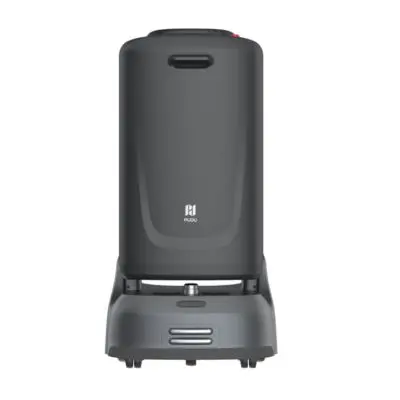
| FlashBot Max | Meals, linen, items and documents in 2–4 closed compartments | 10 kg per shelf 20 kg in total | 60 cm | 20 mm | 9 h | VSLAM+ and LiDAR SLAM; indoor and semi-outdoor | PUDU Link app, API; elevators, doors and turnstiles |
ISO 3691-4 certification applies to the T series. Actual battery life and performance depend on load, routes and floor: we check them with you during the analysis phase.
Good to know before you choose
Actual payload and center of gravity
- Start from the heaviest load, including its container: the stated payload is a maximum value.
- Tall or unbalanced loads: we check center of gravity and securing during the site survey.
- Towing: the T300 reaches 400 kg only with a 200 kg counterweight and at 0.8 m/s.
Passages and floors
- Minimum passage: T300 60 cm, T600 Underride 65 cm, T600 70 cm, PuduBot 2 80 cm.
- Thresholds up to 20 mm for T300 and T300L, 10 mm for T600 and MP2000; slopes up to 5° for the T series, 3° for the MP2000 at full load.
- MP2000: 2 m aisles for 90° pick-up, flat and smooth floor.
Safety and ISO 3691-4
- T series compliant with ISO 3691-4; for the T300, CE-MD and CE-RED issued by TÜV SÜD.
- LiDAR, depth cameras, anti-collision bumper and emergency stop: it slows down or stops.
Elevators and doors
- T300 series: LoRa elevator kit, installed by the maintenance company, with data SIM.
- FlashBot Max: KONE and OTIS via cloud; PUDU control module for other systems.
- Doors and turnstiles with PUDU modules; we check make, model and year during the site survey.
Calling and integration
- One-button PUDU Pager (LoRa network, up to 720 m from the gateway), touchscreen or PUDU Link app.
- WMS, MES and ERP send missions via API and receive status and position in real time.
- T600 series: VDA 5050 for mixed fleets and on-premise or private cloud installation.
PUDU OS, API and PUDU Skill
- Maps without tapes, magnets or QR codes: if the layout changes, you update the map, not the floor.
- PUDU Scheduler coordinates up to 20 T300 robots; the MP2000 fleet also coordinates offline.
- Open Platform (Cloud API) and PUDU Skill to write the integration with your systems faster.
Frequently asked questions
AGV or AMR: what is the difference?
A traditional AGV follows fixed paths (magnetic tapes, wire guidance, QR codes or reflectors) and stops in front of an obstacle until someone clears it. An AMR robot, like PUDU's T series, builds a map of the environment, plans its own route and goes around obstacles: it is installed without any floor work and, when the layout changes, you simply update the map. The T300 installs up to 70% faster than a traditional AGV.
How many robots do I need?
It depends on trips per hour, distances, loads, and loading and unloading times: we calculate it with you during the analysis phase. You can start with one robot and add more: PUDU Scheduler coordinates up to 20 T300 robots at the same site, the T600 series also works with robots from other brands (VDA 5050), and MP2000 robots coordinate with each other even without a network or server.
How do you assess the return on investment?
Start from the transport tasks that people do today with carts and pallet trucks: how many trips a day, how long, how much time to load and unload. During the site survey we measure the flows with you and estimate the hours freed up and the number of robots. As a reference, in “order-to-person” picking with the T300 you can handle up to 2–3 times as many orders per day, with 99.95% accuracy.
Can the robots work alongside people?
Yes. The T series complies with ISO 3691-4, the safety standard for driverless industrial trucks; for the T300, TÜV SÜD has issued CE-MD and CE-RED certifications. LiDAR, depth cameras, anti-collision bumper and emergency stop detect people and obstacles: the robot slows down or stops, and lights and audible warnings show where it is going. The T600 handles right of way with forklifts and, with the emergency module, moves to a safe area in the event of an alarm.
Is a Wi‑Fi network needed?
A connection is needed for the PUDU Link app, calls from company systems, the APIs and the coordination of T-series robots. PUDU Pagers use their own wireless LoRa network and also work without internet; the MP2000 fleet also coordinates offline, but a network is needed to assign tasks from the app or API. During the analysis phase we check coverage with you along the routes and at loading and unloading points.
Can the robots take the elevator and pass through automatic doors?
Yes, with PUDU modules. The T300 series uses the LoRa elevator kit, which calls the elevator without accessing its internal systems; it is installed by the maintenance company and requires a data SIM. The T600 series has modules for elevators and doors and, with several elevators, chooses the free one. The FlashBot Max uses KONE and OTIS elevators via cloud, with no changes to the installation. Automatic doors and turnstiles are connected with PUDU modules. We check the make, model and year of the installations during the site survey.
Can they be connected to the WMS, MES or ERP?
Yes, with the PUDU Open Platform (Cloud API): your system sends missions and receives status, position and errors in real time. There are no ready-made connectors for specific software: the integration is developed on the APIs, and PUDU Skill, a package for AI programming tools, helps you write it faster. The T600 series also supports VDA 5050 and on-premise installation. As the distributor, we activate API access and support your IT team or integrator.
Pallet transport robot or autonomous forklift: which should you choose?
The MP2000 is an autonomous pallet truck: it carries pallets up to 2,000 kg floor to floor, with forks rising from 80 to 200 mm, between docks, warehouse and line side. If you need to stack pallets or put them into racking, you need a forklift. For pallets up to 1.2 × 1.6 m and 600 kg there is also the T600 Underride with the universal bracket.
Which robot for hospitals, offices and hotels?
For light deliveries: the FlashBot Max has closed compartments that open with a PIN, phone or NFC and takes the elevator on its own, so it is suited to multiple floors; the PuduBot 2 has large trays and works well in corridors at least 80 cm wide. For heavier carts of linen, materials or waste, up to 300 kg, there is the T300, also with towing. We do not offer the FlashBot Max for medicines or clinical samples.
How long does installation take? Who does it?
No floor work is needed: the map is created by moving the robot along the routes, then loading and unloading points, calls and integrations are defined. Timing depends on area, points and connections; for “order-to-person” picking with the T300 it takes less than a week. LeanProducts, official PUDU distributor in Italy, handles site survey and flow analysis, installation, mapping, integration and training, with direct support throughout Italy and demos on request.